


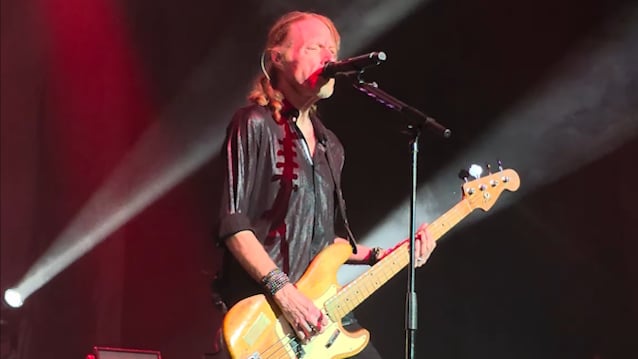
JEFF PILSON Says TRACY G Was 'Very Underrated' As DIO's Guitarist: 'He Was A Brilliant Player'
February 8, 2026In a new interview with Spain's Stairway To Rock, former DOKKEN and current FOREIGNER bassist Jeff Pilson reflected on "Strange Highways" (1993) and "Angry Machines" (1996),which are considered DIO's most controversial and "angry" albums, marking what at the time was divisive shift toward a darker, heavier, and more modern sound influenced by 1990s grunge/metal. He said (as transcribed by BLABBERMOUTH.NET): "'Strange Highways' and 'Angry Machines' were such fun records to make. And, yeah, what a lineup. I mean, Vinny [Appice, drums], Ronnie [James Dio, vocals], Tracy ['G' Grijalva, guitar]. I love Tracy G's guitar playing. He was very underrated, in my opinion. He was not respected as much as he should have been, 'cause he was a brilliant player and a great guy to just improvise with. And that band was so much fun. We had so much fun together. It was really, really great making those records."
After the interviewer noted that a lot of DIO fans didn't like the darker, experimental edge of Ronnie James Dio's mid-1990s era, due in large part to Tracy's much different playing style to that of his predecessors, Vivian Campbell and Craig Goldy, Jeff said: "I know. I know that. We know that. And I just think it's a real drag because it was great. I mean, if we would've been a new band and not called DIO, I think a lot of people would've appreciated it, but, of course, when you have Ronnie in the band [laughs], it's kind hard not to call it DIO. So, yeah, I know. That's an unfortunate thing.
"People have something that they're looking for, and they wanna hear that, and they don't really wanna deviate from that," Jeff explained. "And I understand that. I get that. It's tough when an artist wants to make a change, unless they can bring the audience along with them, it can be very, very frustrating."
Circling back to the fact that Tracy's guitar-playing style wasn't completely embraced by some DIO fans, Jeff added: "So, yeah, we understood that, and it was kind of a shame, but I was proud of Ronnie that he didn't just abandon Tracy right off the bat. He knew about the criticism, but he believed in Tracy, and that speaks volumes about Ronnie's character."
Pilson is best known for playing with DOKKEN and FOREIGNER, but he also toured with DIO in the 1990s and performed on three of the group's albums — the aforementioned "Strange Highways" and "Angry Machines", as well as the group's tenth and final studio release, "Master Of The Moon" (2004).
Tracy reflected on the way he was let go from DIO's band several years ago in an interview with The Metalcast. He said: "One of the last things [Ronnie] said to me on the phone, he goes, 'I wish you were an ass.' He goes, 'I wish you were an ass. That way this would be a lot easier to do, but I really dig you and sorry to say, it has to end now because of powers that be.' So we got along. It wasn't like a big blowout or anything, no. It was just mutual respect and he just said a lot of his fans didn't dig what I was doing and his new record company wanted him to go back to one of his first guitar players, if he could. Vivian and him weren't getting along, so the next choice was Craig. And so he went to Craig. The label wanted him to play with guys he used to play with. He also brought back in Jimmy Bain when I left. It's all a business thing, 'cause they wanted more of the first guys so that they'd sell more tickets — the original DIO lineup. It's all about money to the business people — money, money, money. I don't think the albums after me sold way more than 'Strange Highways'. I really don't know, but I doubt if they did. They weren't any better. They weren't as good, as far as I'm concerned, but that's just me. But he has to go where his manager points him, and it's a business, unfortunately. I wish it was just people playing music, what they wanna play. But the business gets into it, and, 'Well, if you wanna get this record deal, you've gotta get rid of that guy 'cause Tracy's going the wrong way. Tracy's bringing all this weird new shit in and people don't dig that, so get rid of that guy.' That kind of vibe. So he apologized for that. And what he first wanted me to do was stay in the band and have Craig Goldy in the band too and just have me play rhythm guitar now. And I declined. I said, 'Ah, fuck that. What do I wanna do that for? I played lead guitar for six years. Now I'm gonna play rhythm just to stay in a band. Just to stay in Dio's band and be the rhythm guitar player.' I said, 'I'm better than that, as far as I'm concerned. So, no, thanks. No, thanks.' So then he had to let me go, 'cause I didn't wanna stand in the back and just play rhythm and let the Craig Goldy thing go. I don't even dig Craig Goldy's solo playing. I'm not even a fan of his. It'd be different if he was bringing in someone that I loved. I'd be, like, well, 'Let me think about it.' But he was gonna bring in someone that was, like — I'm not even a fan of his. He's not a fan of mine, I'm sure, but who cares? Whatever. But so I stepped out. I'm the one who said, 'No, I won't do that.' And then he said, 'Okay, let's forget we had this conversation and just go on.' And I said, 'Okay.' And then a week later he called again and said he's gotta let me go. So that's how it went."
Tracy G played with DIO from 1993 to 1999 and was featured on the aforementioned two studio albums, "Strange Highways" and "Angry Machines", and one live album, "Inferno: Last In Live", as well as a concert film, "Live In London, Hammersmith Apollo 1993".
A year ago, Tracy was asked by Chris Akin Presents why he never joined another nationally touring act after his departure from DIO. He responded: "'Cause of me. It was my decision. 'Cause I said, 'Okay, I was in DIO. [Ronnie James Dio is a] pretty great singer. [It] doesn't get much better than that. Should I seek out something' like you just said, 'something bigger?' I had too much stuff I wanted to say myself. And I was getting turned on to these little home studios. Now I can record stuff myself. I just wanted to sit in my room and record what's in my head and not have anybody tell me anything, basically. I wanted to do what I wanted to do, and I was kind of tired of being led around type of thing, being in somebody else's band. I did that. I did it the best I could until Ronnie wanted me — they wanted me to play with another guitar player. They didn't kick me out of the band. First they said, 'Well, Tracy, the record company, they wanna add one of our old guitar players.' Craig Goldy got the gig and he was one of their old guitar players. And they got [bassist] Jimmy Bain back too, cause those guys were part of the original DIO, and they wanted to sell more tickets because life is about money. The world is about money. The business is about money. I mean, that's why we're here, right? Well, no, but that's how the world looks at it, right? Me, I'm, like, the things I wanna say. So, I had already played lead guitar and did two or three albums with Ronnie, and now they wanted me to step in the back and let somebody more known, more known in DIO, like Craig Goldy play the solos, which I'm not even a fan of his — sorry, but I'm not even a fan of his. He's probably not a fan of mine [either]. So, oh, just to be a rock star and keep getting some money, I gotta stay in DIO? No. No. No. What's important to me is saying what I wanna say on the guitar. That's what I do."


 Prev
Prev 